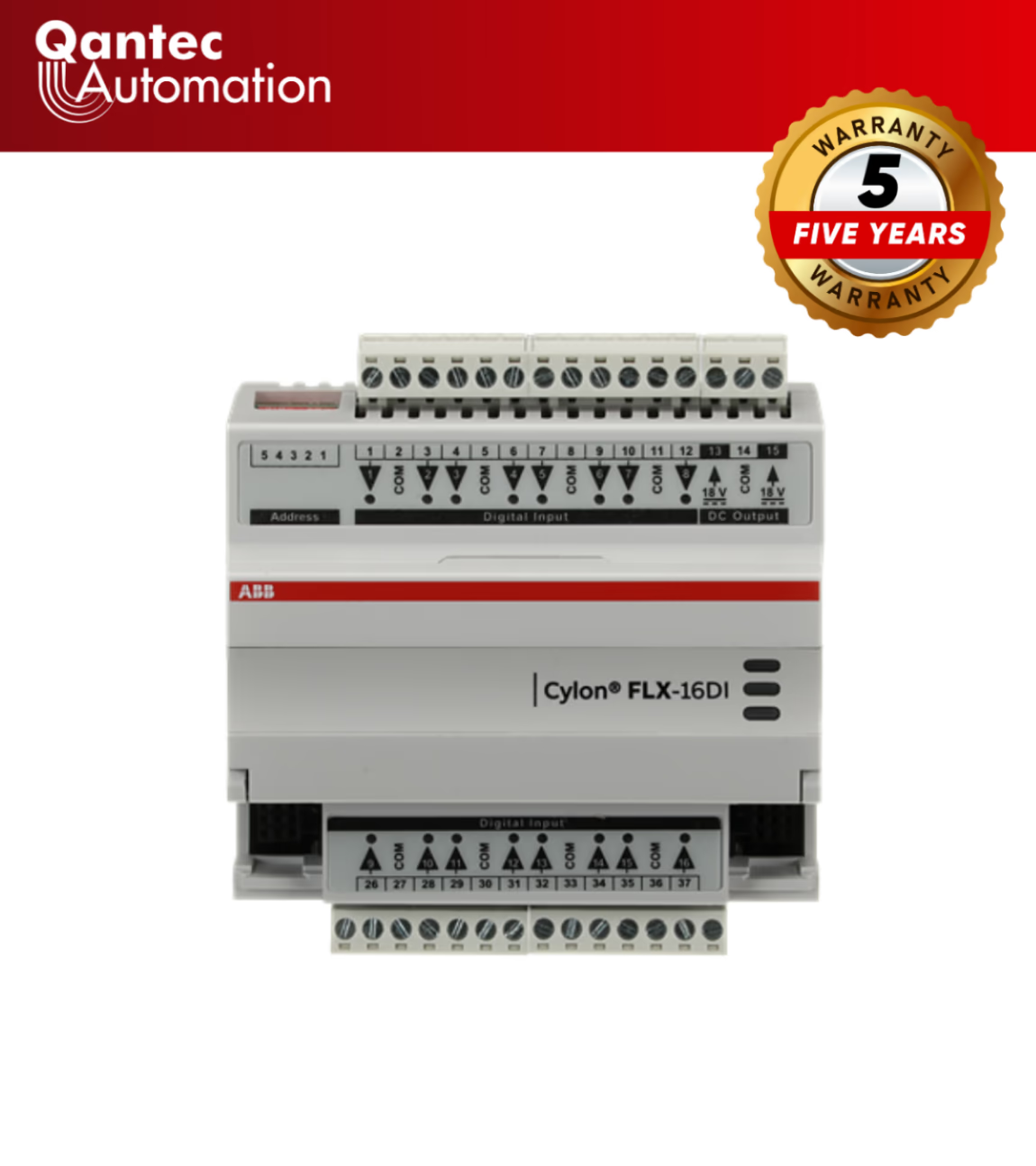
ABB Cylon FLX-16DI 16-Channel Digital Input Module
Sixteen dedicated digital inputs, no outputs or analog points — pair with an FLX-8R8 for control.
AUD $685.30 inc. GST

Field-level I/O module expansion for ABB Cylon CBX, CBXi and FBXi BACnet (Building Automation and Control network) controllers — software-configurable UniPuts™, relay outputs and volt-free digital inputs on a single proprietary bus. Specified, configured and stocked in Australia for systems integrators who need points online this week, not back-ordered.
[ Primary CTA Button: Request Trade Pricing ] [ Secondary CTA Button: Download ABB FLX Datasheet ]
SECTION 3 — CATEGORY INTRO BLOCK
Qantec Automation is the only authorised ABB Cylon distributor in Australia, supplying the FLX (Field Level eXpansion) hardware range as a sister company within the Oberix Group. Each I/O module terminates field sensor and actuator wiring and presents those signals as addressable points to a building management system (BMS), extending a single host controller by up to sixteen points per unit. Every model is held in local stock with engineering support, so an analog input module or relay output board ships without the lead times of an overseas order.
SECTION 4 — PRODUCT RANGE
SECTION 5 — FEATURED PRODUCTS
SECTION 6 — CTA BAR
Genuine ABB Cylon stock, valid firmware and a point-type sanity check before you commit a purchase order. Talk to an integrator who programs these boards, not a call centre reading a spec sheet.
[ CTA Button: Get Trade Pricing ]
SECTION 7 — DETAILED CONTENT
On this page: Range and Architecture · Module Specifications · Australian Compliance · Why Specify Qantec · Common Questions
An I/O module is the field-level hardware that terminates sensor and actuator wiring and converts those physical signals into addressable data points for a building management system. Each ABB Cylon FLX I/O module resolves analog inputs through an on-board 16-bit analog-to-digital converter and switches relay contacts rated to 24 V AC, 2 A resistive, then hands every point upstream to a host controller for object exposure.
The defining feature of the range is the UniPut™: a single hardware connection that is software-configurable as an analog input, digital input, analog output or relay digital output. That flexibility is what turns one FLX-8R8 into either an analog input module, a set of analog output modules driving valves and dampers, or a mixed analog input output module — without changing the wiring topology. You commit copper once; you assign point type later in software.
An FLX I/O module does not carry its own IP address. Each I/O module clips onto a proprietary FLX-bus running at 115.2K Baud, and the host controller — not the module — presents the points to the network. This matters for two reasons: the field I/O layer is inherently segregated from any IP attack surface, and the maximum I/O module count is set by the host, not the expansion module itself. Those per-host limits are set out below:
| Host Controller | Max FLX Modules | Max Points | Power Note |
|---|---|---|---|
| CBX (BACnet MS/TP) | 3 | 64 | Bus-powered |
| CBXi (BACnet/IP) | 5 | — | FLX-PS24 required beyond 3 |
| FBXi/IP | 16 | 256 | FLX-PS24 required beyond 3 |
Bus length is the constraint integrators most often miss. The FLX-bus tolerates a 30 m / 100 ft run on 18 AWG conductors, dropping to 15 m / 50 ft on thinner 22 AWG. Where a plant room forces an I/O module away from the controller, the FLX-RMC remote module connector and FLX-bus interconnect carry power and comms across that gap — these and the FLX-PS24 are stocked alongside the boards as [FLX-bus power and remote-mounting accessories](#) [Link to: Accessories & Kits Main Category Page]. Each I/O module clips to standard DIN rail in a flame-retardant ABS housing measuring 104 × 89.5 × 57 mm, drawing 24 V AC at 16 VA.
Every FLX I/O module pairs with the host [ABB Cylon BACnet field controllers](#) [Link to: BACnet Controllers Sub-Category Page] over that same bus, and the full point capacity and 115.2K Baud bus speed are published in ABB's Field Level eXpansion datasheet. Group each I/O module correctly and you avoid both the over-spend of an unused expansion module and the rework of discovering a point shortfall at commissioning.
| Parameter | Specification |
|---|---|
| Inter-module bus | Proprietary FLX-bus, 115.2K Baud |
| Max bus length | 30 m / 100 ft (18 AWG); 15 m / 50 ft (22 AWG) |
| Unit rating | 24 V AC ±20%, 50/60 Hz, 16 VA |
| Auxiliary sensor power | 18 V DC, 60 mA per unit |
| Analog-to-digital conversion | On-board 16-bit ADC |
| Analog output resolution | 0–10 V @ 20 mA max, 12-bit |
| Relay contact rating | 24 V AC, 2 A resistive (1 A inductive) |
| Universal input range | 0–10 V, 0–450 kΩ, 0–20 mA, −40 to +110 °C |
| Pulse counting | Up to 20 Hz |
| Mounting / enclosure | DIN rail; flame-retardant ABS, 104 × 89.5 × 57 mm |
| Approvals | UL916 Listed (CDN & US), File No. E176435; EN 61326-1 EMC |
The FLX-8R8 (1M101100) is the workhorse 16-point I/O module: eight UniPuts with relay plus eight universal inputs. Because every UniPut is software-selectable, one I/O module can present as a bank of relay outputs for fan and damper control, run as a digital input output module for plant status and switching, switch its UniPuts to 0–10 V analog output modules for valves, or — flipped entirely to sensing — behave as an 8 channel analog input module reading 10k thermistors and 0–10 V transmitters. Universal inputs accept voltage, resistance, current and temperature, with ±0.5% full-scale analog accuracy.
The FLX-8R8-H (1M101102) carries the identical point count and adds a Hand/Off/Auto local override on every output, with a status LED per I/O channel indicating fault or override state. Specify the -H variant wherever a technician must force plant manually — a supply fan, a pump, a heating valve — during commissioning or a BMS outage. The override is a hard mechanical layer beneath the software, which is exactly what a maintenance team needs when the head-end is offline.
You can wire the [FLX-8R8 I/O module](#) [Link to: ABB FLX-8R8 (1M101100) Product Page] as a pure analog input output module for an air-handling unit, mixing modulating outputs with sensor returns on the same physical card.
The FLX-4R4 (1M101106) halves the count to four UniPuts with relay and four universal inputs — eight points in the same compact footprint. Specified as an IO expansion module for zone-level plant, it suits jobs where a full sixteen-point I/O module is over-specified: a single fan coil bank, a tenancy sub-board, or a small pump set. The same UniPut logic applies, so this ABB analog input module configuration flips to a relay output card, to a compact analog input output module for mixed sensing and modulation, or to a true digital input output module — depending on how its points are assigned.
The FLX-4R4-H (1M101108) adds the same Hand/Off/Auto override and per-channel LEDs as its larger sibling, giving a zone-level io expansion module with hardwired manual control. Where local manual control of a small plant item is a contractual or safety requirement, the -H card delivers it without forcing you up to an eight-output board. Both 4R4 variants draw from the host controller's bus power, so they count against the three-module budget on a CBX before a FLX-PS24 is required.
The FLX-16DI (1M101110) is a dedicated 16-channel digital input module with no outputs and no analog points. It reads volt-free contacts at 2 mA contact-wetting current and counts pulses up to 20 Hz, which makes this ABB digital input module the natural choice for high-density status and metering work: plant run/fault feedback, door and tamper contacts, and pulse-output utility meters. Used as a digital input/output module the FLX range relies on the UniPut boards for outputs, so the FLX-16DI is paired with an FLX-8R8 I/O module where both status monitoring and control are needed on one controller. Paired this way, the two boards present to the controller as a combined digital input output module, with the FLX-16DI handling status and the FLX-8R8 driving outputs.
For NCC sub-metering specifically, the 20 Hz pulse-counting ceiling is the figure to check against your meter's pulse rate before you commit the channel.
An I/O module is the field device through which an Australian building's compliance data is physically captured, converting metered pulses, temperatures and status contacts into the data points a building management system can log. Under NCC 2022 Section J.9, energy use must be metered by end-use category, and the FLX pulse-counting inputs (up to 20 Hz on both UniPut and digital channels) feed that sub-metered data to the host controller's trend logs.
NABERS ratings depend on that same sub-metered data, so the FLX pulse channels also underpin verifiable energy reporting — see NABERS energy rating guidance for the underlying metering expectations. For mechanical ventilation under AS 1668.2, FLX UniPuts configured as analog output modules (0–10 V) modulate damper actuators and variable-speed drives for outside-air control. Under the WHS Act 2011, the Hand/Off/Auto override on the FLX-8R8-H and FLX-4R4-H supports safe manual isolation and operation of plant during maintenance, independent of the head-end.
At the integration layer, each FLX point is exposed by the host controller as a standard BACnet object — analog input, analog output, binary input or binary output — under ASHRAE Standard 135. That object model is what keeps the I/O module vendor-agnostic to a master systems integrator, even though the boards themselves speak only the proprietary FLX-bus. Field wiring follows AS/NZS 3000, using the copper or copper-clad-aluminium 70 °C conductors (AWG 12 to AWG 22) the datasheet specifies.
The strongest security property of the FLX architecture is structural: the boards have no IP interface. Every I/O module communicates only over the proprietary 115.2K Baud FLX-bus, so the addressable attack surface is the host controller, not the field I/O. Harden that controller across both layers. At the network layer, place the BACnet/IP host controllers on a dedicated building-services VLAN segregated from corporate IT, reach them for remote engineering through a VPN tunnel rather than port-forwarding, and enforce role-based access controls at the BMS supervisor. At the firmware layer, flash only ABB-signed firmware sourced through Qantec, and confirm the documented power-status-bus LED boot sequence after every upgrade to verify integrity. Physically, house each I/O module in a lockable enclosure, retain shielded cabling on all input runs, and treat the Hand/Off/Auto override positions on -H cards as an auditable manual-control event.
Can one FLX board be both an analog input module and an output card at the same time?
Yes. Each UniPut on an FLX-8R8 or FLX-4R4 is independently software-configurable as AI, DI, AO or DO-R, so a single I/O module can mix analog inputs, modulating analog outputs and relay outputs across its channels simultaneously. Only the FLX-16DI is fixed — it provides digital inputs exclusively.
How many FLX expansion modules can I add to one controller?
It depends entirely on the host. A CBX controller accepts up to three FLX modules for sixty-four total points, a CBXi accepts up to five when fitted with a FLX-PS24 power supply module, and an FBXi/IP controller scales to sixteen modules and 256 points.
What is the maximum cabling distance for the FLX-bus?
The FLX-bus runs up to 30 m / 100 ft on 18 AWG conductors, or 15 m / 50 ft on 22 AWG, including any extension cable. Beyond the controller's bus-power budget — three modules on most hosts — a FLX-PS24 must inject additional power before you extend further.
Does the FLX-16DI count electricity or water meter pulses for NCC sub-metering?
Yes. The FLX-16DI digital input module counts volt-free pulses up to 20 Hz, suiting standard kWh, water and gas meter pulse outputs. Confirm your meter's pulse frequency sits under that 20 Hz ceiling, then map each channel to a BACnet object on the host controller for NABERS and NCC Section J reporting.
SECTION 8 — FOOTER CTA
Qantec stocks the complete ABB Cylon FLX I/O module range in Australia with genuine firmware and same-week dispatch, backed by integrators who program these boards daily. Send through your point schedule and we will confirm module count, UniPut assignment and host controller compatibility before you raise a single purchase order.
[ CTA Button: Request Trade Pricing ] [ CTA Button: Download ABB FLX Datasheet ] [ CTA Button: Talk to an Integrator ]
Qantec Automation — part of the Oberix Group | ABN 52 623 495 901
SECTION 9 — EXTENDED FAQ
How are ABB Cylon FLX modules addressed on the FLX-bus?
Every FLX I/O module is assigned a unique bus address with on-board DIP switches, and those addresses must run consecutively starting at zero. If two devices share an address — including the host controller — the controller's lower yellow status LED blinks slowly to signal the clash, so set the switches before energising the trunk. Because address order tracks the physical order of each I/O module on the bus, the hardware point numbering in CXproᴴᴰ stays predictable.
Does the FLX-bus require end-of-line termination?
Yes — the FLX-bus is terminated at the right-hand connector of the last I/O module on the trunk. The bus runs as a daisy-chain outward from the host controller, so the termination point sits at the far module, never at the controller. Correct termination prevents signal-reflection communication faults on longer runs approaching the 30 m / 100 ft ceiling on 18 AWG conductors.
Can one FLX I/O module work on both MS/TP and BACnet/IP controllers?
Yes — the same FLX module is interchangeable across the CBX BACnet MS/TP family and the CBXi and FBXi BACnet/IP family. The board only ever communicates over the proprietary FLX-bus, so whether the host publishes points by MS/TP or by IP is the controller's role, not the module's. That lets you hold one pool of spare I/O module stock across a mixed MS/TP and IP estate.
When does an FLX installation need the FLX-PS24 power supply module?
A host controller powers up to three FLX modules from its own bus, so the fourth I/O module onward requires a FLX-PS24 power supply module. The FLX-PS24 also enables remote mounting of an I/O module, injecting power at the far end of an extended FLX-bus so it can sit in a distant plant room. On a three-module CBX you rarely need one; on a five-module CBXi or a sixteen-module FBXi you will.
How should the 24 V AC supply to an FLX module be earthed?
The common 24 V AC terminal must be tied to Earth, and ABB recommends making that earth connection at the 24 V AC transformer itself. Each module runs from 24 V AC ±20% at 16 VA, and a single correctly earthed transformer keeps the FLX-bus reference consistent across every I/O module on the trunk. Multiple or floating earth points are the usual root cause of drifting analog input readings.
Are FLX module inputs and outputs protected against wiring faults?
Yes — every FLX input and output is protected against short circuit and against over-voltage up to 24 V AC. That covers the most common commissioning fault, an accidental cross between a signal pair and the 24 V AC supply, without destroying the channel. It is not licence for mains contact, though: 230 V AC onto a terminal will still damage the board, so keep all field wiring at extra-low voltage.
What do the FLX status LEDs indicate during operation?
In normal operation each FLX module shows a steady red LED, a blinking green LED and an unlit yellow LED, while a rotating Red-Green-Yellow sequence means the I/O section is rebooting. A fast-blinking point LED flags an error on that channel, and two short flashes followed by a value indicate an output held in override. These tool-free diagnostics let an installer confirm I/O module health without a laptop.
Can an FLX UniPut output be overridden without the head-end software?
Yes — on the -H variants every UniPut output can be forced with the on-board Hand/Off/Auto switch, independent of the head-end or network. Standard boards still support a software override applied from CXproᴴᴰ, but only the -H hardware override survives a supervisor outage. An overridden output shows two short flashes followed by its value, so the manual state is visible on the board itself.
Is the FLX-bus the same network as BACnet MS/TP?
No — the FLX-bus is a separate proprietary inter-module bus running at 115.2K Baud, distinct from the host's RS-485 BACnet MS/TP trunk. An FLX module never appears directly on the BACnet network; the host controller polls it across the FLX-bus and republishes each point as a BACnet object. Plan the two as different cabling layers with their own length and segregation budgets.
SECTION 10 — SEO SCHEMA IMPLEMENTATION NOTES
<script type="application/ld+json">
{
"@context": "https://schema.org",
"@graph": [
{
"@type": "Person",
"@id": "https://qantecautomation.com/product-category/building-automation/io-expansion-modules/#reviewer-1",
"name": "Stephen Ford",
"jobTitle": "Business Development Manager",
"email": "s.ford@qantecautomation.com",
"worksFor": {
"@type": "Organization",
"name": "Qantec Automation"
}
},
{
"@type": "Person",
"@id": "https://qantecautomation.com/product-category/building-automation/io-expansion-modules/#reviewer-2",
"name": "Dr. Abhishek Mitra",
"jobTitle": "Business Development Manager (NSW)",
"email": "a.mitra@qantecautomation.com",
"worksFor": {
"@type": "Organization",
"name": "Qantec Automation"
},
"hasCredential": {
"@type": "EducationalOccupationalCredential",
"credentialCategory": "PhD in IoT Devices"
}
},
{
"@type": "WebPage",
"@id": "https://qantecautomation.com/product-category/building-automation/io-expansion-modules/",
"url": "https://qantecautomation.com/product-category/building-automation/io-expansion-modules/",
"name": "Multi-Function IO Expansion Modules | ABB FLX | Australia",
"description": "ABB FLX multi-function I/O modules — analog, digital & expansion. Only authorised ABB Cylon distributor. Configure your BMS.",
"inLanguage": "en-AU",
"isPartOf": {
"@type": "WebSite",
"name": "Qantec Automation",
"url": "https://qantecautomation.com"
},
"reviewedBy": [
{
"@id": "https://qantecautomation.com/product-category/building-automation/io-expansion-modules/#reviewer-1"
},
{
"@id": "https://qantecautomation.com/product-category/building-automation/io-expansion-modules/#reviewer-2"
}
],
"about": {
"@type": "Product",
"name": "ABB Cylon FLX I/O Expansion Modules",
"brand": {
"@type": "Brand",
"name": "ABB Cylon"
}
},
"publisher": {
"@type": "Organization",
"name": "Qantec Automation",
"identifier": "ABN 52 623 495 901",
"parentOrganization": {
"@type": "Organization",
"name": "Oberix Group"
}
}
}
]
}
</script>
<script type="application/ld+json">
{
"@context": "https://schema.org",
"@type": "FAQPage",
"mainEntity": [
{
"@type": "Question",
"name": "Can one FLX board be both an analog input module and an output card at the same time?",
"acceptedAnswer": {
"@type": "Answer",
"text": "Yes. Each UniPut on an FLX-8R8 or FLX-4R4 is independently software-configurable as AI, DI, AO or DO-R, so a single I/O module can mix analog inputs, modulating analog outputs and relay outputs across its channels simultaneously. Only the FLX-16DI is fixed — it provides digital inputs exclusively."
}
},
{
"@type": "Question",
"name": "How many FLX expansion modules can I add to one controller?",
"acceptedAnswer": {
"@type": "Answer",
"text": "It depends entirely on the host. A CBX controller accepts up to three FLX modules for sixty-four total points, a CBXi accepts up to five when fitted with a FLX-PS24 power supply module, and an FBXi/IP controller scales to sixteen modules and 256 points."
}
},
{
"@type": "Question",
"name": "What is the maximum cabling distance for the FLX-bus?",
"acceptedAnswer": {
"@type": "Answer",
"text": "The FLX-bus runs up to 30 m / 100 ft on 18 AWG conductors, or 15 m / 50 ft on 22 AWG, including any extension cable. Beyond the controller's bus-power budget — three modules on most hosts — a FLX-PS24 must inject additional power before you extend further."
}
},
{
"@type": "Question",
"name": "Does the FLX-16DI count electricity or water meter pulses for NCC sub-metering?",
"acceptedAnswer": {
"@type": "Answer",
"text": "Yes. The FLX-16DI digital input module counts volt-free pulses up to 20 Hz, suiting standard kWh, water and gas meter pulse outputs. Confirm your meter's pulse frequency sits under that 20 Hz ceiling, then map each channel to a BACnet object on the host controller for NABERS and NCC Section J reporting."
}
},
{
"@type": "Question",
"name": "How are ABB Cylon FLX modules addressed on the FLX-bus?",
"acceptedAnswer": {
"@type": "Answer",
"text": "Every FLX I/O module is assigned a unique bus address with on-board DIP switches, and those addresses must run consecutively starting at zero. If two devices share an address — including the host controller — the controller's lower yellow status LED blinks slowly to signal the clash, so set the switches before energising the trunk. Because address order tracks the physical order of each I/O module on the bus, the hardware point numbering in CXproᴴᴰ stays predictable."
}
},
{
"@type": "Question",
"name": "Does the FLX-bus require end-of-line termination?",
"acceptedAnswer": {
"@type": "Answer",
"text": "Yes — the FLX-bus is terminated at the right-hand connector of the last I/O module on the trunk. The bus runs as a daisy-chain outward from the host controller, so the termination point sits at the far module, never at the controller. Correct termination prevents signal-reflection communication faults on longer runs approaching the 30 m / 100 ft ceiling on 18 AWG conductors."
}
},
{
"@type": "Question",
"name": "Can one FLX I/O module work on both MS/TP and BACnet/IP controllers?",
"acceptedAnswer": {
"@type": "Answer",
"text": "Yes — the same FLX module is interchangeable across the CBX BACnet MS/TP family and the CBXi and FBXi BACnet/IP family. The board only ever communicates over the proprietary FLX-bus, so whether the host publishes points by MS/TP or by IP is the controller's role, not the module's. That lets you hold one pool of spare I/O module stock across a mixed MS/TP and IP estate."
}
},
{
"@type": "Question",
"name": "When does an FLX installation need the FLX-PS24 power supply module?",
"acceptedAnswer": {
"@type": "Answer",
"text": "A host controller powers up to three FLX modules from its own bus, so the fourth I/O module onward requires a FLX-PS24 power supply module. The FLX-PS24 also enables remote mounting of an I/O module, injecting power at the far end of an extended FLX-bus so it can sit in a distant plant room. On a three-module CBX you rarely need one; on a five-module CBXi or a sixteen-module FBXi you will."
}
},
{
"@type": "Question",
"name": "How should the 24 V AC supply to an FLX module be earthed?",
"acceptedAnswer": {
"@type": "Answer",
"text": "The common 24 V AC terminal must be tied to Earth, and ABB recommends making that earth connection at the 24 V AC transformer itself. Each module runs from 24 V AC ±20% at 16 VA, and a single correctly earthed transformer keeps the FLX-bus reference consistent across every I/O module on the trunk. Multiple or floating earth points are the usual root cause of drifting analog input readings."
}
},
{
"@type": "Question",
"name": "Are FLX module inputs and outputs protected against wiring faults?",
"acceptedAnswer": {
"@type": "Answer",
"text": "Yes — every FLX input and output is protected against short circuit and against over-voltage up to 24 V AC. That covers the most common commissioning fault, an accidental cross between a signal pair and the 24 V AC supply, without destroying the channel. It is not licence for mains contact, though: 230 V AC onto a terminal will still damage the board, so keep all field wiring at extra-low voltage."
}
},
{
"@type": "Question",
"name": "What do the FLX status LEDs indicate during operation?",
"acceptedAnswer": {
"@type": "Answer",
"text": "In normal operation each FLX module shows a steady red LED, a blinking green LED and an unlit yellow LED, while a rotating Red-Green-Yellow sequence means the I/O section is rebooting. A fast-blinking point LED flags an error on that channel, and two short flashes followed by a value indicate an output held in override. These tool-free diagnostics let an installer confirm I/O module health without a laptop."
}
},
{
"@type": "Question",
"name": "Can an FLX UniPut output be overridden without the head-end software?",
"acceptedAnswer": {
"@type": "Answer",
"text": "Yes — on the -H variants every UniPut output can be forced with the on-board Hand/Off/Auto switch, independent of the head-end or network. Standard boards still support a software override applied from CXproᴴᴰ, but only the -H hardware override survives a supervisor outage. An overridden output shows two short flashes followed by its value, so the manual state is visible on the board itself."
}
},
{
"@type": "Question",
"name": "Is the FLX-bus the same network as BACnet MS/TP?",
"acceptedAnswer": {
"@type": "Answer",
"text": "No — the FLX-bus is a separate proprietary inter-module bus running at 115.2K Baud, distinct from the host's RS-485 BACnet MS/TP trunk. An FLX module never appears directly on the BACnet network; the host controller polls it across the FLX-bus and republishes each point as a BACnet object. Plan the two as different cabling layers with their own length and segregation budgets."
}
}
]
}
</script>
<script type="application/ld+json">
{
"@context": "https://schema.org",
"@type": "ItemList",
"name": "ABB Cylon FLX I/O Expansion Modules",
"itemListElement": [
{
"@type": "ListItem",
"position": 1,
"item": {
"@type": "Product",
"name": "ABB FLX-8R8 (1M101100)",
"sku": "1M101100",
"brand": {
"@type": "Brand",
"name": "ABB Cylon"
},
"description": "8 UniPuts with relay + 8 universal inputs; 16-point multi-function expansion board."
}
},
{
"@type": "ListItem",
"position": 2,
"item": {
"@type": "Product",
"name": "ABB FLX-8R8-H (1M101102)",
"sku": "1M101102",
"brand": {
"@type": "Brand",
"name": "ABB Cylon"
},
"description": "16-point board with Hand/Off/Auto local override and per-channel status LEDs."
}
},
{
"@type": "ListItem",
"position": 3,
"item": {
"@type": "Product",
"name": "ABB FLX-4R4 (1M101106)",
"sku": "1M101106",
"brand": {
"@type": "Brand",
"name": "ABB Cylon"
},
"description": "4 UniPuts with relay + 4 universal inputs; compact 8-point module."
}
},
{
"@type": "ListItem",
"position": 4,
"item": {
"@type": "Product",
"name": "ABB FLX-4R4-H (1M101108)",
"sku": "1M101108",
"brand": {
"@type": "Brand",
"name": "ABB Cylon"
},
"description": "8-point module with Hand/Off/Auto local override and per-channel status LEDs."
}
},
{
"@type": "ListItem",
"position": 5,
"item": {
"@type": "Product",
"name": "ABB FLX-16DI (1M101110)",
"sku": "1M101110",
"brand": {
"@type": "Brand",
"name": "ABB Cylon"
},
"description": "dedicated 16-channel digital input module for volt-free contacts and pulse metering."
}
}
]
}
</script>
Showing 5 of 5 Products
Sixteen dedicated digital inputs, no outputs or analog points — pair with an FLX-8R8 for control.
AUD $685.30 inc. GST
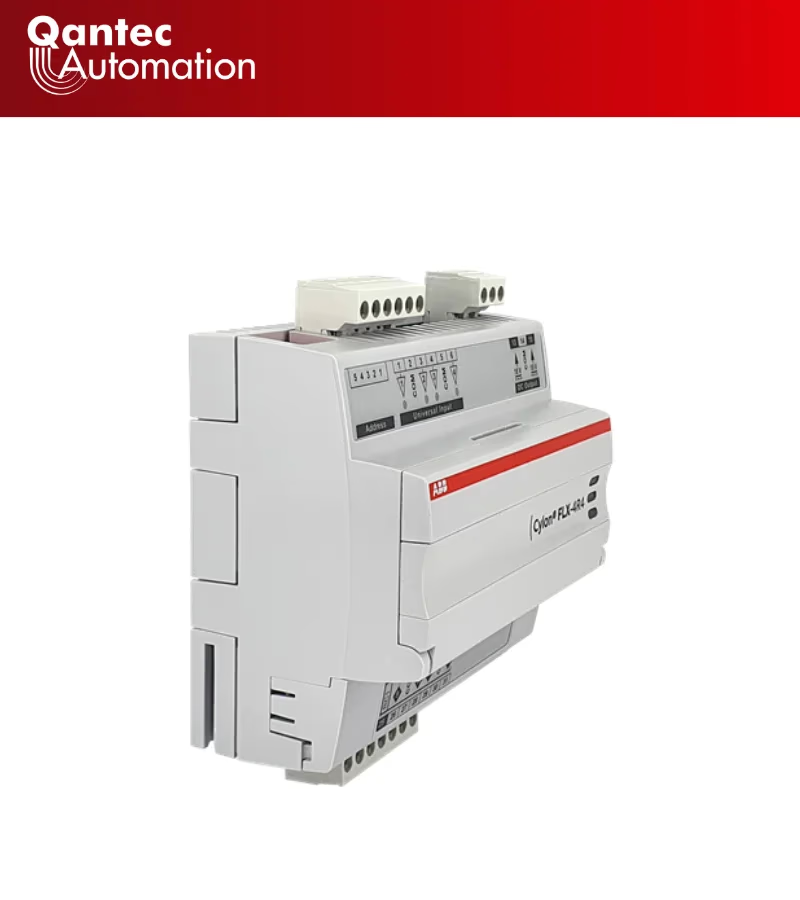
Four relay UniPuts and four universal inputs — eight points, each configurable as AI, DI, AO or DO-R.
AUD $654.50 inc. GST
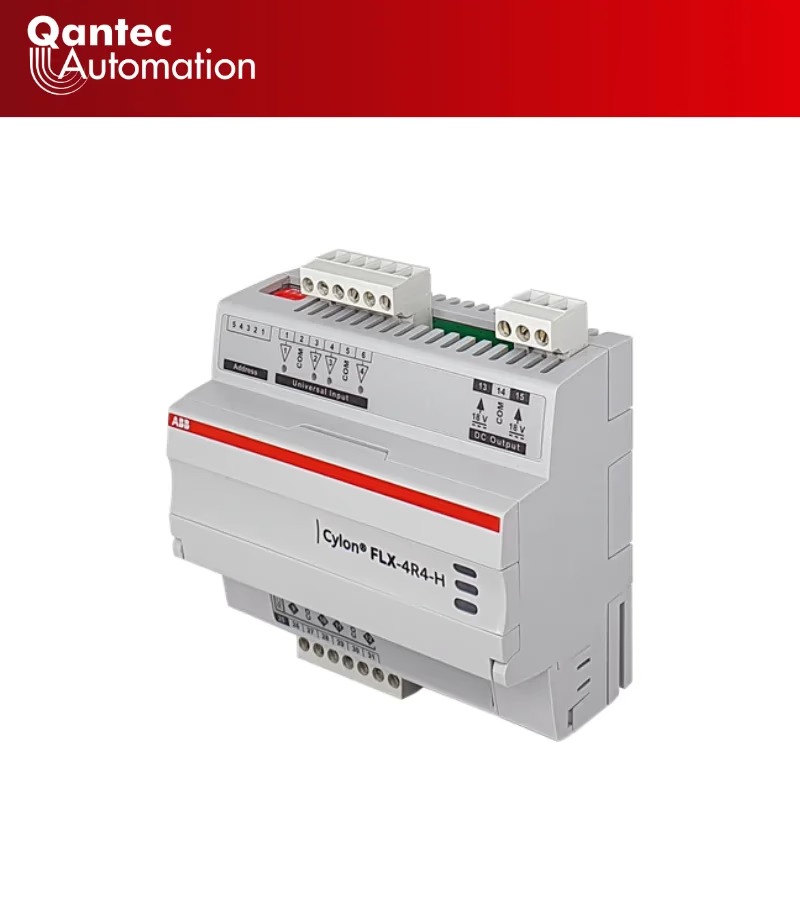
The FLX-4R4 with Hand/Off/Auto override and a status LED on every channel.
AUD $797.50 inc. GST
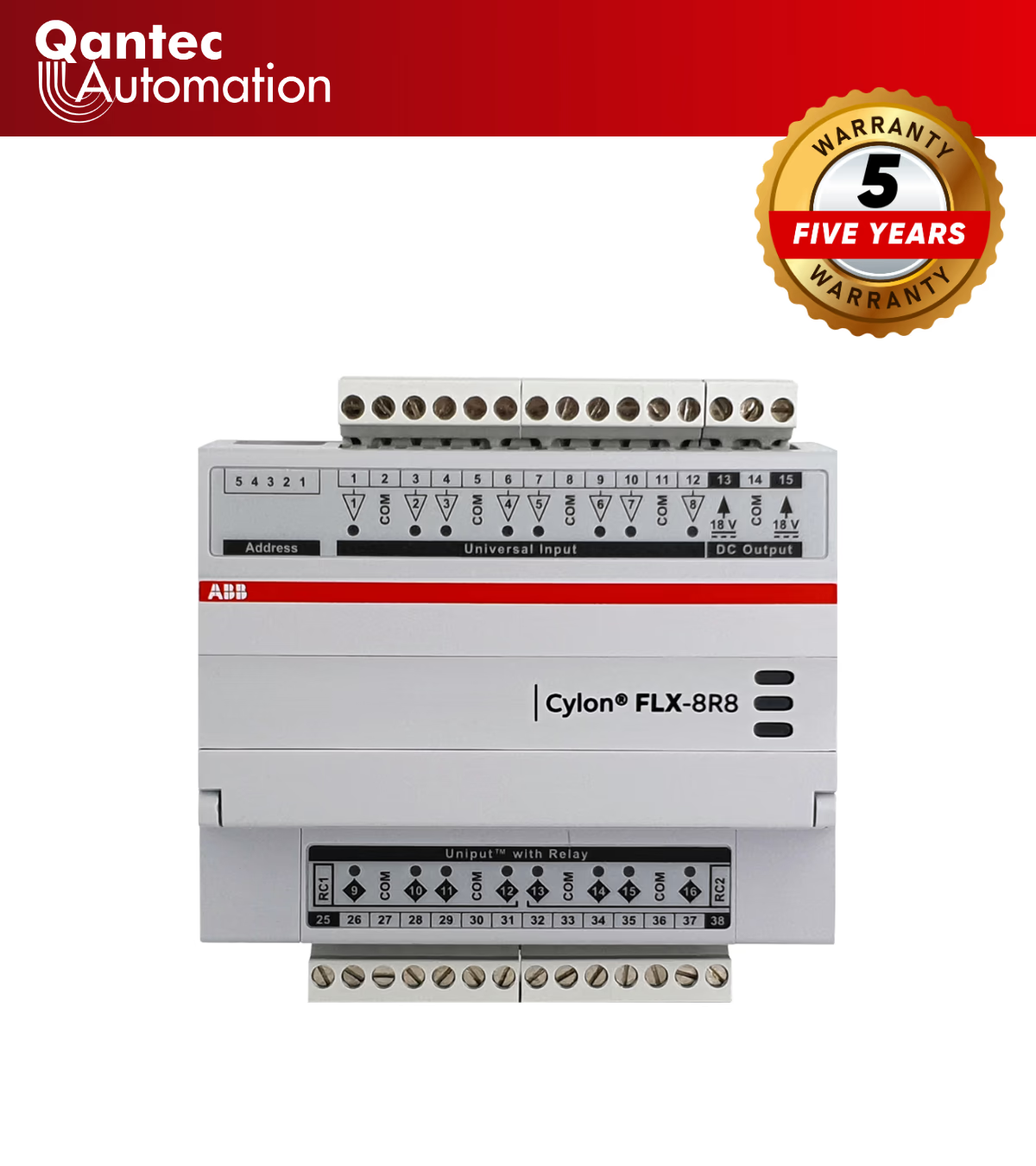
The 16-point workhorse — eight relay UniPuts and eight universal inputs, mixable on one card.
AUD $838.20 inc. GST
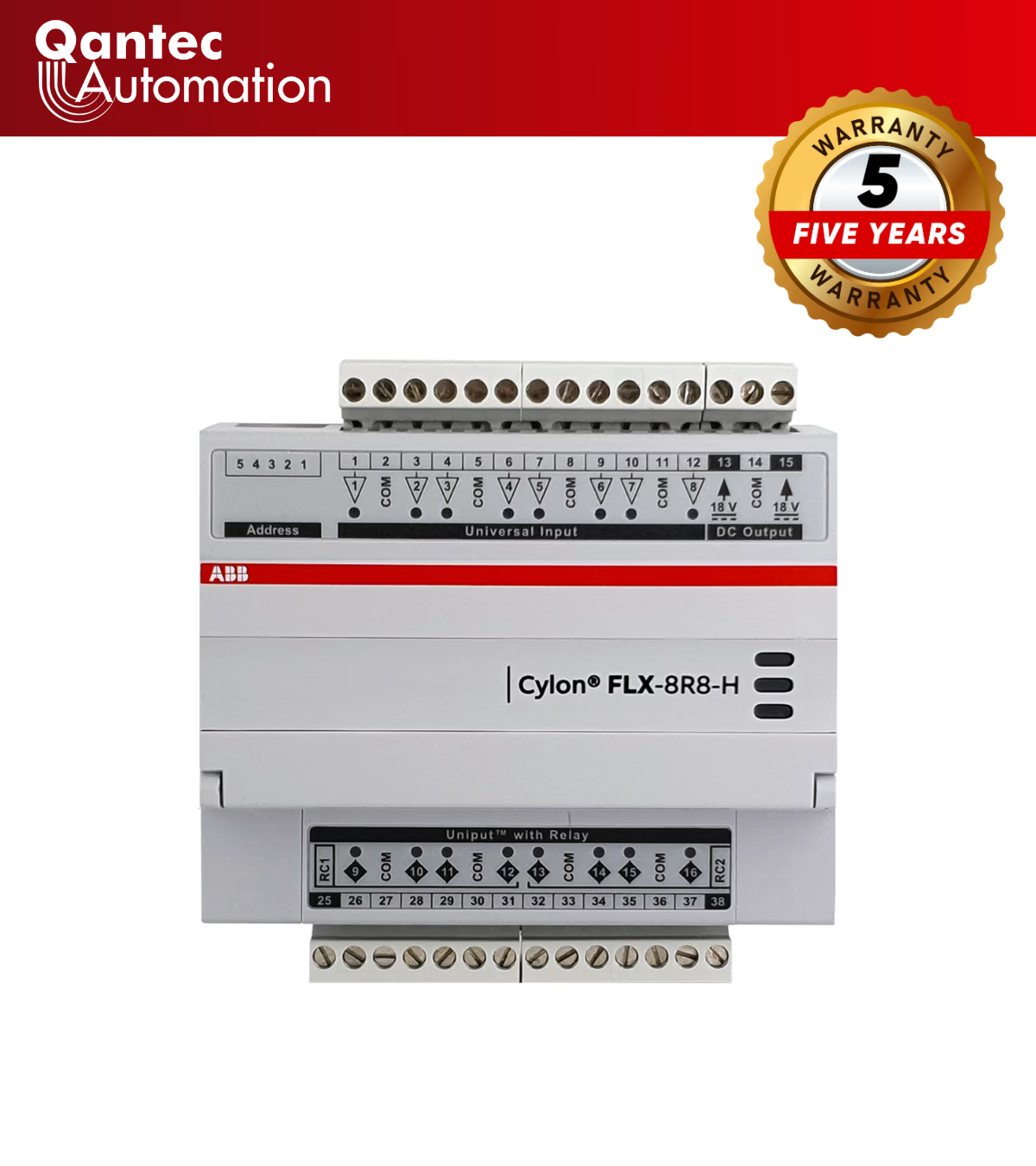
The FLX-8R8 point count with Hand/Off/Auto override on every output and a status LED per channel.
AUD $1,150.60 inc. GST