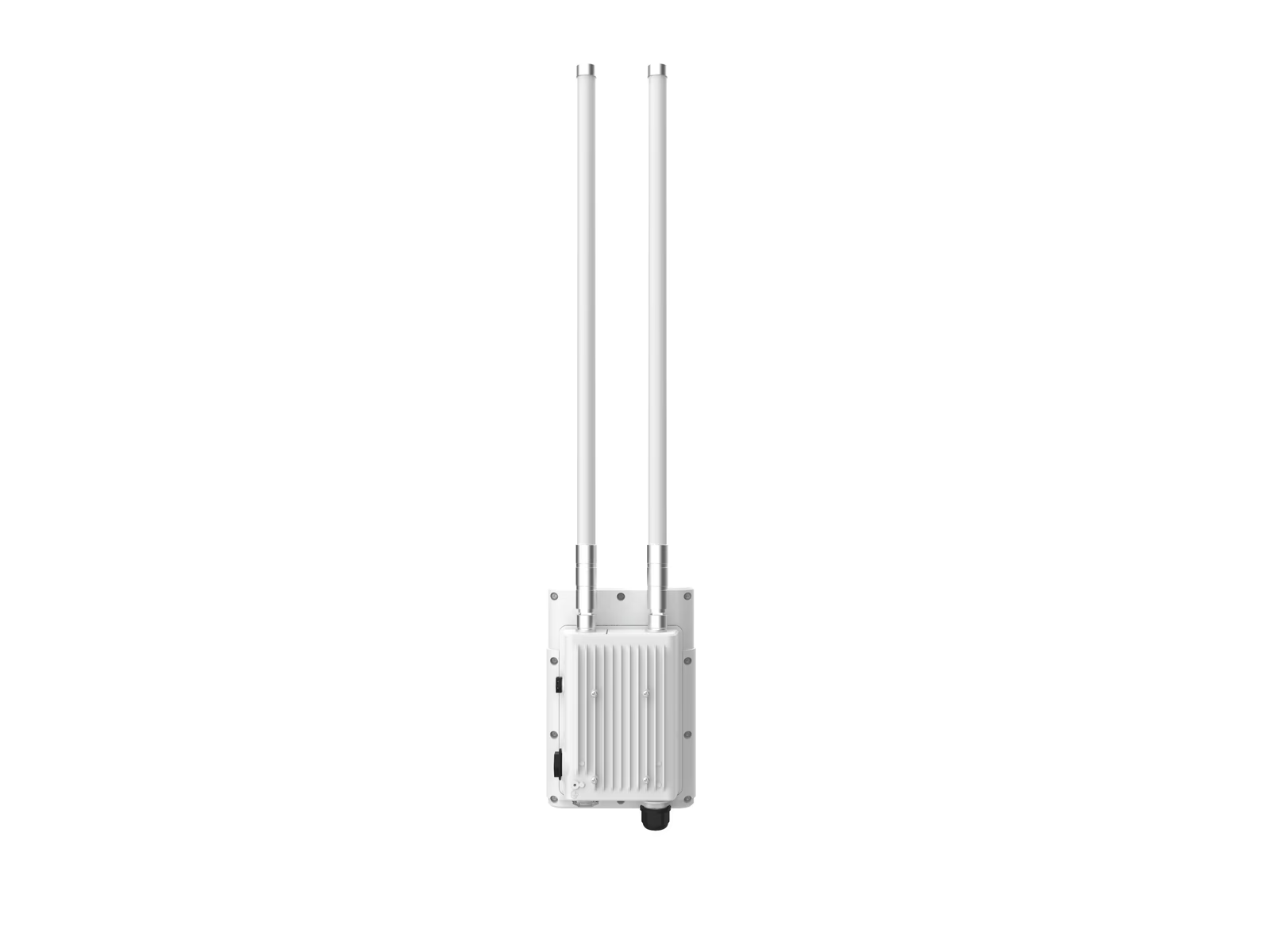
Milesight UG67 Outdoor LoRaWAN Gateway
IP67 macrocell with eight full-duplex channels, PoE, 4G LTE and supercapacitor ride-through.
AUD $981.20 – AUD $1,219.90 inc. GST

[Developer note: confirm Dr. Mitra’s exact title/credentials and link his author-bio page for full author-entity E-E-A-T.]
Hero Tagline / Subtitle: Qantec Automation supplies LoRaWAN, Wi-Fi HaLow, 4G LTE, edge, and BACnet-integrated gateways and controllers to systems integrators and BMS engineers across Australia, in strategic partnership with Milesight (announced 2024). Every device ships AU915-configured, locally stocked, and backed by our AU technical team.
Primary CTA Button: Speak with Our AU Technical Team Secondary CTA Button: Browse Sub-Categories ↓
[Developer note — Hero image alt text:] Gateways and Controllers for Industrial IoT Networks — Qantec Automation Australia
(3 sentences — placed directly below hero, above sub-category tiles)
Qantec Automation is an official Milesight partner in Australia, stocking industrial IoT gateways and controllers across LoRaWAN, Wi-Fi HaLow, 4G LTE, and edge platforms for commercial and industrial building automation. This gateways and controllers range spans the UG-series and EG71 aggregation gateways, the UC-series industrial IoT controllers, the HL31 Wi-Fi HaLow gateway, the UR32 cellular router, and the Milesight industrial PoE switch. Every device ships pre-configured for the AU915–928 MHz LoRaWAN band, backed by Qantec’s local technical support team.
(Numbered for WooCommerce tile rendering)
[Developer note: Three products carry “Not Applicable” in the product mapping sub-category column — Milesight Industrial PoE Switch, Milesight UR32, and Milesight HL31. These display directly under this main category page outside the sub-category tile structure. Confirm WooCommerce product assignment reflects this.]
(WooCommerce auto-populated from product assignments in this category.)
[Developer note: Recommended featured products for manual curation if required — UG67, EG71, HL31, UC300, UR32.]
Headline: Need Gateways and Controllers Specified for Your Project?
Body copy: Qantec’s AU technical team advises on node capacity, backhaul selection, BACnet integration, and AU915 configuration. All Milesight gateways and controllers are AU-stocked, with trade pricing for registered integrators.
CTA Button: Request Trade Pricing
The sections below detail the Milesight gateways and controllers in this category: specifications, protocol selection, Australian compliance, and answers to common specification questions.
Industrial IoT gateways and controllers are the network and control devices that link field sensors to building and operational platforms: gateways aggregate wireless sensor data and forward it over Ethernet, 4G, or Wi-Fi, while controllers run local automation logic. Milesight LoRaWAN models serve 2,000+ nodes per gateway on the AU915–928 MHz band.
These gateways and controllers form the layer between edge sensors and the systems that act on their data — a SCADA platform, a BACnet (Building Automation and Control Networks) BMS, or a cloud dashboard. The Milesight gateways and controllers range covers both functions: dedicated aggregation gateways, the EG71 IoT edge gateway for multi-protocol edge computing, and UC-series industrial IoT controllers for field-level automation.
The UC-series industrial IoT controllers — UC100, UC300, UC501, UC502, and UC51X — run local IF-THEN logic, drive relay and valve outputs, and store readings offline when connectivity drops. Explore the IoT Controllers range for full UC-series specifications and trade pricing across the gateways and controllers. [Link to: IOT Controllers sub-category page — Sufyan: assign correct sub-category URL once taxonomy is built]
Milesight LoRaWAN gateways are Semtech SX1302-based, 8-channel industrial IoT gateways pre-configured for the AU915–928 MHz band. All six models — UG67, UG65, UG63, UG56, EG71, and SG50 — share the SX1302 chipset, LoRaWAN Class A/B/C support, an embedded network server, and FUOTA (Firmware Update Over the Air). The embedded network server manages 2,000+ sensor nodes and runs firmware updates without cloud connectivity, so one device serves an entire multi-storey building.
A free BACnet/IP driver across these gateways and controllers presents LoRaWAN sensor data as BACnet/IP objects inside an existing BMS — a direct saving versus third-party converters — making these gateways and controllers a primary choice for BMS engineers deploying alongside ABB Cylon controllers. Explore the LoRaWAN Gateway range for full specifications and AU trade pricing. [Link to: LoRaWAN Gateway sub-category page — Sufyan: assign correct sub-category URL once taxonomy is built]
The UG67 is an IP67-rated outdoor industrial IoT gateway for rooftops, campus networks, and perimeter coverage, achieving 15 km line-of-sight (2 km urban) per the UG67 datasheet. It adds simultaneous Ethernet, cellular, and Wi-Fi backhaul, integrated GPS, capacitor ride-through, and VPN tunnels — the primary choice for outdoor IoT sensor gateway deployments across Australian campuses and stormwater networks. View Milesight UG67 specifications [Link to: Milesight UG67 product page]
[Developer note — Product image alt text:] Milesight UG67 Outdoor LoRaWAN IoT Gateway — Gateways & Controllers
The UG65 is an IP65-rated indoor unit on an NXP quad-core processor for plant rooms, data centres, and indoor industrial spaces where PoE is preferred. It shares the UG67’s AU915 architecture and node capacity, adding Ethernet, Wi-Fi, and cellular backhaul, with an IP65 rating for plant-room condensation and wash-down. View Milesight UG65 specifications [Link to: Milesight UG65 product page]
[Developer note — Product image alt text:] Milesight UG65 Semi-Industrial Indoor LoRaWAN Gateway — Gateways & Controllers
The UG63 is a compact, half-duplex mini gateway with an integrated network server for up to 50 nodes — the cost-effective entry point for one office floor, a small facility, or a retail fit-out where full 2,000-node capacity is unnecessary. View Milesight UG63 specifications [Link to: Milesight UG63 product page]
[Developer note — Product image alt text:] Milesight UG63 Mini LoRaWAN IoT Gateway — Gateways & Controllers
The UG56 is a DIN rail-mounted industrial unit rated for three-floor RF penetration in dense commercial structures, for MCC panel or switchboard installation. With Ethernet and cellular backhaul, it is the preferred specification for BMS retrofits serving multiple floors through reinforced-concrete plates. View Milesight UG56 specifications [Link to: Milesight UG56 product page]
[Developer note — Product image alt text:] Milesight UG56 DIN Rail Industrial LoRaWAN Gateway — Gateways & Controllers
The EG71 is Milesight’s multi-protocol building BMS gateway and the flagship for BACnet-integrated smart buildings. On a quad-core 1.5 GHz Cortex-A53 with 2 GB DDR4, it natively bridges BACnet/IP, BACnet MS/TP, Modbus TCP/RTU, KNX TP, and M-Bus alongside LoRaWAN on AU915. As an IoT edge gateway it consolidates LoRaWAN data, BACnet polling, and Modbus metering into one processing point, removing the parallel protocol converters that add cost and failure points to BMS projects. View Milesight EG71 specifications [Link to: Milesight EG71 product page]
[Developer note — Product image alt text:] Milesight EG71 Building BMS IoT LoRaWAN Gateway — Gateways & Controllers
The SG50 is an IP67-rated solar-powered outdoor unit for grid-independent sites. A 30 W panel (45 W optional) gives up to four days of operation without solar input per the SG50 datasheet, and 4G LTE backhaul suits remote water monitoring, agricultural IoT sensor gateway deployments, and perimeter infrastructure without mains power. View Milesight SG50 specifications [Link to: Milesight SG50 product page]
[Developer note — Product image alt text:] Milesight SG50 Solar-Powered Outdoor LoRaWAN Gateway — Gateways & Controllers
Milesight industrial IoT controllers are LoRaWAN-connected field devices combining programmable I/O, local logic, and edge decision-making for autonomous operation without continuous connectivity. An IoT device controller such as the UC300 or UC100 executes up to 16 IF-THEN rules locally, drives relay outputs, and stores up to 800 readings offline, resuming transmission when the link returns.
These industrial IoT controllers fill a gap gateway-only deployments cannot: local actuation and closed-loop control at the field level, used to control IoT devices independently of BMS polling and cloud latency. Under the Work Health and Safety Act 2011, an IoT control system that keeps triggering outputs during a network outage is a material safety consideration in gas detection, ventilation, and equipment-shutdown applications, where the gateways and controllers must keep operating. Browse all IoT Controllers. [Link to: IOT Controllers sub-category page — Sufyan: assign correct sub-category URL once taxonomy is built]
The UC100 is a Modbus-to-LoRaWAN IoT device controller that reads up to 32 Modbus RTU RS485 devices and 64 registers, transmitting via LoRaWAN Class C on AU915. Rated IP30 for panel installation, it brings legacy Modbus energy meters, drives, and sensors into a LoRaWAN network without rewiring. View Milesight UC100 specifications [Link to: Milesight UC100 product page]
The UC300 is a multi-interface industrial IoT device controller with digital inputs, relay outputs, 4–20 mA and 0–10 V analogue inputs, PT100 RTD inputs, RS232, and RS485, transmitting via LoRaWAN AU915 or 4G LTE. It runs 16 IF-THEN rules locally for autonomous IoT control system operation and mounts on DIN rail, wall, or desktop. View Milesight UC300 specifications [Link to: Milesight UC300 product page]
The UC501 is an IP67 solar-powered outdoor IoT device controller supporting GPIO, RS232/RS485, analogue inputs, and SDI-12 — for remote environmental monitoring, agriculture, and outdoor infrastructure without mains power, via LoRaWAN Class A on AU915. The CSOX solar kit (K023 pole or K024 wall mount) from Accessories & Kit is the compatible accessory. [Link to: Accessories & Kit category page]
The UC502 is the battery-powered IoT device controller variant of the UC501, sharing the same interface set at IP67 with LoRaWAN Class A on AU915. It suits temporary and relocatable deployments where solar or mains cabling is not viable — construction-site monitoring, short-term compliance campaigns, and seasonal sensing. View Milesight UC502 specifications [Link to: Milesight UC502 product page]
The UC51X (UC511 and UC512) is an IP68-rated controller with 2 valve outputs and 2 digital inputs for water-meter pulse counting, built for submersible and wet-area use. Its M12 connector and IP68 rating suit valve pits, irrigation manifolds, and stormwater infrastructure where remote actuation is required. View Milesight UC51X specifications [Link to: Milesight UC51X product page]
Three Milesight devices in this category sit outside the sub-category structure and display directly under the main category: the industrial PoE switch, the UR32 cellular router, and the HL31 Wi-Fi HaLow gateway. Each complies with its respective standard — IEEE 802.3af/at, 3G/4G LTE, and IEEE 802.11ah — and complements the gateways and controllers range.
The Milesight industrial PoE switch comes in 4, 8, 16, and 24-port configurations, all IEEE 802.3af/at at 30 W per port. The 24-port model delivers 400 W total PoE across 2 SFP fibre uplinks — enough to power a full floor of PoE gateways, IP cameras, access-control readers, and other PoE-powered IoT gateway devices from one managed switch. View Milesight Industrial PoE Switch specifications [Link to: Milesight Industrial PoE Switch product page]
[Developer note — Product image alt text:] Milesight Industrial PoE Switch Network Infrastructure — Gateways & Controllers
The UR32 is a Pro Series industrial cellular router with 3G/4G LTE, dual SIM, RS232 (RS485 optional), 2 Ethernet ports, DI/DO, and Wi-Fi. Its VPN suite provides secure site-to-site IoT control system connectivity, and DLMS support suits smart-meter head-end links in Australian energy deployments. View Milesight UR32 specifications [Link to: Milesight UR32 product page]
[Developer note — Product image alt text:] Milesight UR32 Industrial Cellular Router Pro Series — Gateways & Controllers
The HL31 is an IEEE 802.11ah (Wi-Fi HaLow) gateway on sub-1 GHz spectrum — Australia’s designated HaLow band — supporting 200+ nodes, 1 km line-of-sight, and 32 Mbps throughput per the HL31 datasheet. This WiFi HaLow gateway suits building-automation applications needing lower latency and higher throughput than LoRaWAN Class A while giving each endpoint a direct IP address. View Milesight HL31 specifications [Link to: Milesight HL31 product page]
[Developer note — Product image alt text:] Milesight HL31 Wi-Fi HaLow Gateway IEEE 802.11ah — Gateways & Controllers
Choosing the correct gateway protocol means matching the wireless technology to the deployment’s data rate, range, power budget, and licensing, and it determines which gateways and controllers fit the site. In Australia the three options are LoRaWAN on AU915–928 MHz (27 kbps), Wi-Fi HaLow on sub-1 GHz (32 Mbps), and 4G LTE used as backhaul rather than a sensor-side protocol.
| Protocol | Band | Max Data Rate | Range | Node Capacity | Best-fit Use Case |
|---|---|---|---|---|---|
| LoRaWAN | AU915–928 MHz (licence-exempt) | 27 kbps | Up to 15 km LoS / 2 km urban (UG67) | 2,000+ Class A nodes per gateway | Low-power battery sensor networks across large commercial buildings |
| Wi-Fi HaLow (802.11ah) | Sub-1 GHz (licence-exempt) | 32 Mbps | 1 km LoS | 200+ IP-addressed nodes | Higher-throughput, faster-polling, IP-addressed monitoring |
| 4G LTE (backhaul) | Carrier LTE bands | Carrier-dependent | Carrier coverage | n/a (backhaul, not sensor-side) | Remote, temporary, or mobile sites without fixed Ethernet |
For most commercial buildings in Australia, LoRaWAN gateways and controllers remain the primary architecture: one gateway manages 2,000+ Class A nodes with multi-year battery life. A LoRa IoT gateway such as the UG67 or the EG71 IoT edge gateway suits building-wide occupancy and energy applications, while a Wi-Fi HaLow gateway (HL31) is specified where throughput or direct IP addressing exceed LoRaWAN Class A. A 4G IoT gateway pattern — LoRaWAN sensors with 4G backhaul — covers remote sites, and the SG50 adds solar for off-grid operation. Browse the IoT Sensors & Devices range for compatible sensors. [Link to: IoT Sensors & Devices category page]
Gateways and controllers in commercial-building IoT networks underpin several Australian regulatory obligations. NCC Section J.9 mandates circuit-level energy sub-metering above defined floor-area thresholds — a requirement that depends on an IoT sensor gateway layer to collect data from Milesight CT101 (100A), CT103 (300A), and CT105 (500A) current transformers and forward it to energy-management platforms.
The NABERS Indoor Environment rating assesses CO₂, temperature, and relative humidity — measurements collected by LoRaWAN sensors and aggregated through the gateways and controllers, typically via the EG71 IoT edge gateway, before BMS integration. Green Star Buildings v1.1 credits operational energy monitoring and indoor environment quality, both relying on the same infrastructure to aggregate field-sensor data at scale.
Under the WHS Act 2011, gas detection and air-quality monitoring in plant rooms, carparks, and industrial spaces require reliable data paths. The autonomous offline operation of Milesight industrial IoT controllers — local alerts and relay actuation independent of the network — is directly relevant to safety monitoring, where an outage cannot disable hazard detection. The UR32’s DMVPN and dual-SIM redundancy provide carrier failover that keeps the gateways and controllers online during an outage.
For camera and surveillance deployments integrated with these gateways and controllers, the Privacy Act 1988 (Cth) and Australian Privacy Principles govern data collection, storage, and access — a factor in VPN tunnelling and network segmentation. View Milesight camera products. [Link to: Camera category page]
Gateways and controllers specified for Australian projects must ship on the correct AU915–928 MHz frequency plan and integrate cleanly with local BMS and OT networks. Qantec Automation stocks the full Milesight gateways and controllers range — each device AU915-configured for the 2,000-node LoRaWAN architecture — from local inventory, with support from engineers familiar with Australian building codes and BMS topologies. As an official Milesight partner in Australia (strategic partnership announced 2024), Qantec offers trade pricing on its gateways and controllers for integrators, BMS contractors, and facility managers.
Every industrial IoT gateway in the gateways and controllers range supports VPN tunnelling (IPsec, OpenVPN, WireGuard, GRE) for encrypted backhaul, with firmware managed via FUOTA through the embedded network server. VLAN support on the PoE switch and gateway interfaces isolates IoT sensor traffic from corporate IT in line with the Essential Eight, while role-based access, SSH, and HTTPS enforce least privilege. For camera and people-counting data, gateway-level VPN tunnelling supports the data-localisation requirements of the Privacy Act 1988 (Cth).
Q: What is the node capacity of Milesight LoRaWAN gateways? All standard models — UG67, UG65, UG56, EG71, and SG50 — support 2,000+ sensor nodes via the embedded network server per the Milesight datasheet, managed locally with no cloud subscription. The UG63 is the exception at 50 nodes for single-floor and small-site use.
Q: Can Milesight gateways and controllers integrate with a BACnet BMS? Yes. The free BACnet/IP driver presents LoRaWAN sensor data as BACnet/IP objects in an existing BACnet BMS; the EG71 IoT edge gateway additionally supports BACnet/IP and MS/TP natively alongside Modbus TCP/RTU, KNX TP, and M-Bus.
Q: What is the difference between an IoT gateway and an IoT device controller? A gateway aggregates data from multiple sensors and forwards it to a platform, server, or BMS. An IoT device controller such as the UC300 or UC100 adds local I/O, runs IF-THEN logic, drives outputs, and stores data offline — an edge automation device rather than a data router. Many deployments use both — gateways and controllers working together.
Q: Do all Milesight gateways and controllers ship AU915-ready? Yes. Every device through Qantec is pre-configured for AU915–928 MHz per the LoRa Alliance specification. Units sourced through unofficial channels may arrive on EU868 or US915, creating channel-plan mismatches; Qantec’s AU-stocked units ship AU915-ready without field reconfiguration.
Headline: Specify Milesight Gateways and Controllers with Confidence
Body copy: Qantec Automation is an official Milesight partner in Australia with AU-stocked industrial IoT gateways and controllers, full technical documentation, and trade pricing for systems integrators and BMS engineers. Our AU technical team supports product selection, AU915 configuration, BACnet integration, and commissioning.
CTA Buttons:
(8–10 questions unique to this category level — no overlap with in-body FAQ)
Q1: What backhaul options do Milesight LoRaWAN gateways support? Milesight LoRaWAN gateways support Ethernet, 4G LTE cellular, and Wi-Fi backhaul, with model-specific availability. The UG67 and UG65 support all three; the EG71 supports Ethernet, cellular, and Wi-Fi; the UG63 and UG56 support Ethernet and cellular; and the SG50 uses 4G cellular as its sole backhaul, supported by its solar power system. For commercial building deployments, Ethernet is preferred for reliability and latency, with cellular as a primary or automatic failover path on the UG67 and UG65. Sites without fixed connectivity should specify the UG67 (outdoor) or UG56 (DIN rail indoor) with 4G as the primary backhaul.
Q2: How does the HL31 Wi-Fi HaLow gateway differ from a LoRaWAN IoT gateway? Wi-Fi HaLow (IEEE 802.11ah) operates on sub-1 GHz spectrum with up to 32 Mbps peak throughput and 1 km line-of-sight range, supporting over 200 IP-addressed nodes per the HL31 datasheet. LoRaWAN operates at a maximum of 27 kbps, with sensors typically transmitting sub-50-byte payloads and achieving multi-year battery life. The HL31 suits applications requiring higher data rates, faster polling, or direct IP access to each endpoint — higher-resolution environmental monitoring, edge video analytics, or field-level firmware management. LoRaWAN gateways remain the better choice for battery-powered sensors deployed at scale across a large commercial building.
Q3: Can the Milesight EG71 act as a standalone BACnet/IP server in a commercial BMS? Yes. The EG71 presents all connected LoRaWAN sensors, Modbus RS485 devices, KNX nodes, and M-Bus meters as native BACnet/IP objects, functioning as a BACnet/IP server that a BMS workstation or ABB ASPECT supervisor can query directly. This eliminates separate protocol gateways for each fieldbus type, reducing cost and installation complexity for multi-protocol commercial building BMS projects. Qantec’s AU technical team can assist with EG71 BACnet object point mapping and integration testing against ABB Cylon MATRIX-2 and NEXUS-3 controllers.
Q4: What is FUOTA and which Milesight gateways support it? FUOTA (Firmware Update Over the Air) is a LoRaWAN Alliance-standardised mechanism that pushes firmware updates to LoRaWAN end-devices through the gateway’s network server without on-site access. All Milesight LoRaWAN gateways — UG67, UG65, UG63, UG56, EG71, and SG50 — support FUOTA via their embedded network servers. This is operationally critical for commercial deployments: patches, protocol updates, and feature additions reach hundreds of sensors from the gateway management interface, eliminating the disruption of physical site visits for firmware maintenance across distributed networks.
Q5: How do I choose between the Milesight UG67 and UG65 for a commercial building? The UG67 is built for outdoor or harsh environments; the UG65 for protected indoor or semi-industrial spaces. Both share AU915, Semtech SX1302, 8-channel architecture, the embedded network server, and 2,000+ node capacity.
| Spec | UG67 | UG65 |
|---|---|---|
| Ingress rating | IP67 (dust + immersion) | IP65 |
| Environment | Outdoor / rooftop / perimeter | Indoor plant rooms, switch rooms, MDF |
| Power | Capacitor backup (1 min outage) | PoE-powered |
| Processor | Industrial outdoor design | NXP quad-core |
| Positioning | Integrated GPS | — |
| Backhaul | Ethernet + 4G + Wi-Fi (simultaneous) | Ethernet + Wi-Fi + cellular |
If the installation is external, on a rooftop, or in a wet or dirty area, specify the UG67. For plant rooms, switch rooms, and MDF spaces with PoE infrastructure, the UG65 is the more cost-effective choice.
Q6: Does the Milesight UC300 support autonomous offline operation? Yes. The UC300 IoT device controller stores data locally and executes up to 16 IF-THEN automation rules independently of network connectivity. When LoRaWAN or 4G backhaul is unavailable, the UC300 continues to monitor inputs, trigger relay outputs, and log readings, transmitting stored data automatically once connectivity is restored. This is critical for industrial process control and remote monitoring where outages cannot interrupt local actuation — including WHS-mandated safety monitoring and environmental compliance logging.
Q7: What cellular bands does the Milesight UR32 support in Australia? The UR32 Pro Series supports 3G and 4G LTE with dual SIM, compatible with Telstra, Optus, and Vodafone networks in Australia. Dual SIM enables automatic carrier failover where a single carrier’s coverage is marginal or congested. DLMS protocol support suits smart-meter head-end connections in Australian energy and infrastructure applications, and the VPN suite — ZeroTier, IPsec, OpenVPN, GRE, L2TP, PPTP, DMVPN, and WireGuard — provides the secure tunnel options required to connect remote industrial IoT control systems to centralised platforms.
Q8: Can Milesight IoT controllers connect to a third-party LoRaWAN network server? Yes. Milesight controllers and gateways support the standard Semtech UDP packet-forwarder protocol and are compatible with third-party LoRaWAN network servers including ChirpStack, The Things Network (TTN), Actility ThingPark, and AWS IoT Core for LoRaWAN, in addition to the built-in embedded network server. This open architecture lets existing infrastructure from other vendors be extended with Milesight gateways and controllers without changing the network server platform or sensor data pipeline.
Q9: What power backup options exist for Milesight LoRaWAN gateways? The UG67 includes a capacitor backup for one minute of continued operation during a mains interruption. For extended continuity across all Milesight gateways and controllers, the Milesight UPS01 (IP67+IK08, 12,000 mAh, 32-hour backup) from the Accessories & Kit range is the compatible uninterruptible power supply. The UPS01 supports remote monitoring via the device GUI and is compatible with the UG-series gateways, making it the standard specification where downtime would interrupt energy metering, safety monitoring, or NABERS IEQ data collection. [Link to: Accessories & Kit category page]
Q10: Are Milesight gateways and controllers compatible with the Milesight Network Server cloud platform? Yes. In addition to the embedded local network server on each gateway, Milesight gateways and controllers are compatible with the Milesight Network Server (MNS) cloud platform for centralised fleet management across multiple sites. A single operations team can monitor device status, manage provisioning, push FUOTA updates, and view network performance from one dashboard. For Australian deployments, Qantec’s AU technical team can advise on on-premise versus cloud network server configurations based on data sovereignty, latency, and operational requirements.
Showing 2 of 14 Products
IP67 macrocell with eight full-duplex channels, PoE, 4G LTE and supercapacitor ride-through.
AUD $981.20 – AUD $1,219.90 inc. GST
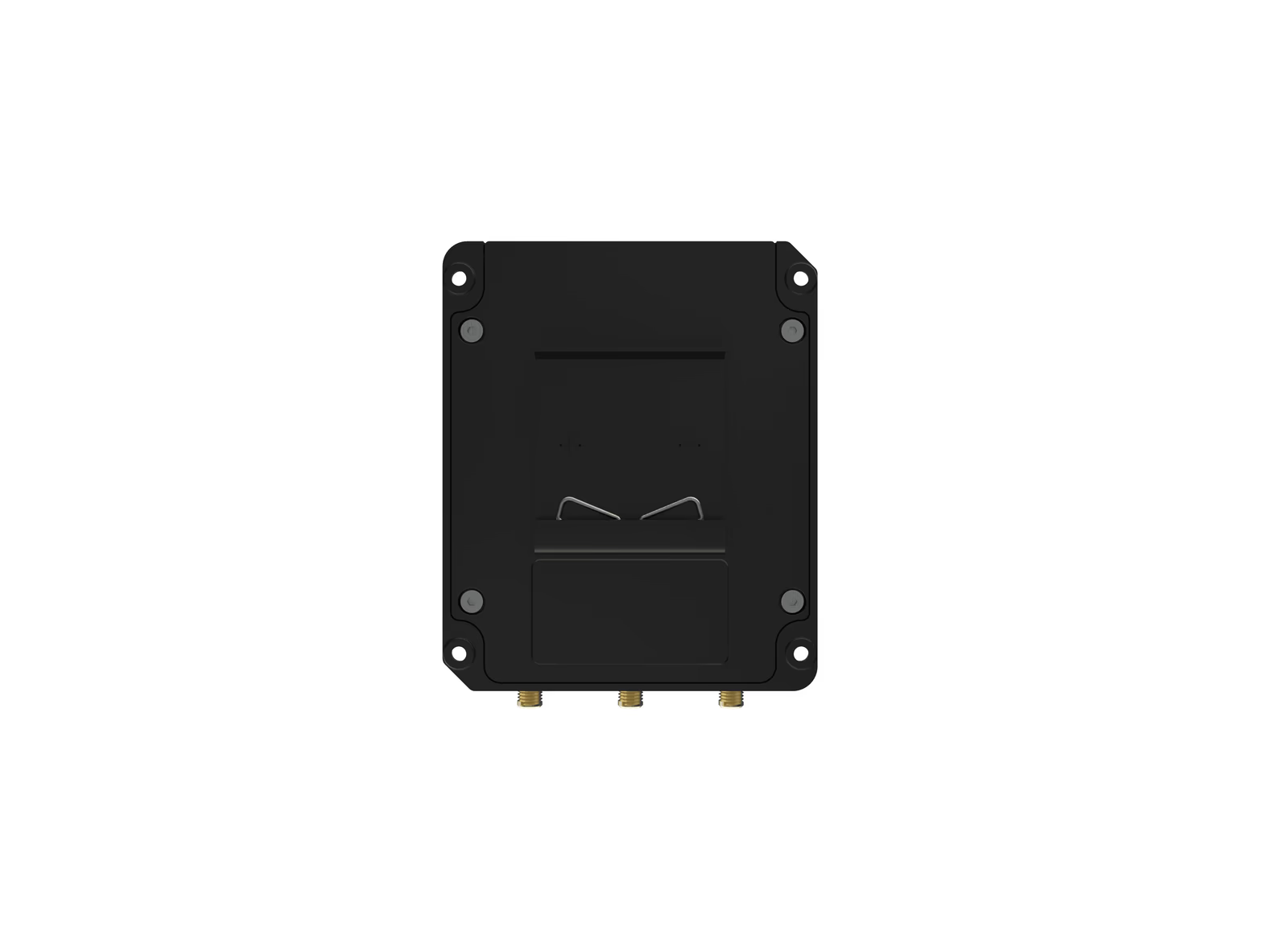
Industrial cellular routing for remote sites, from the Milesight UR Pro series.
AUD $305.80 – AUD $325.60 inc. GST